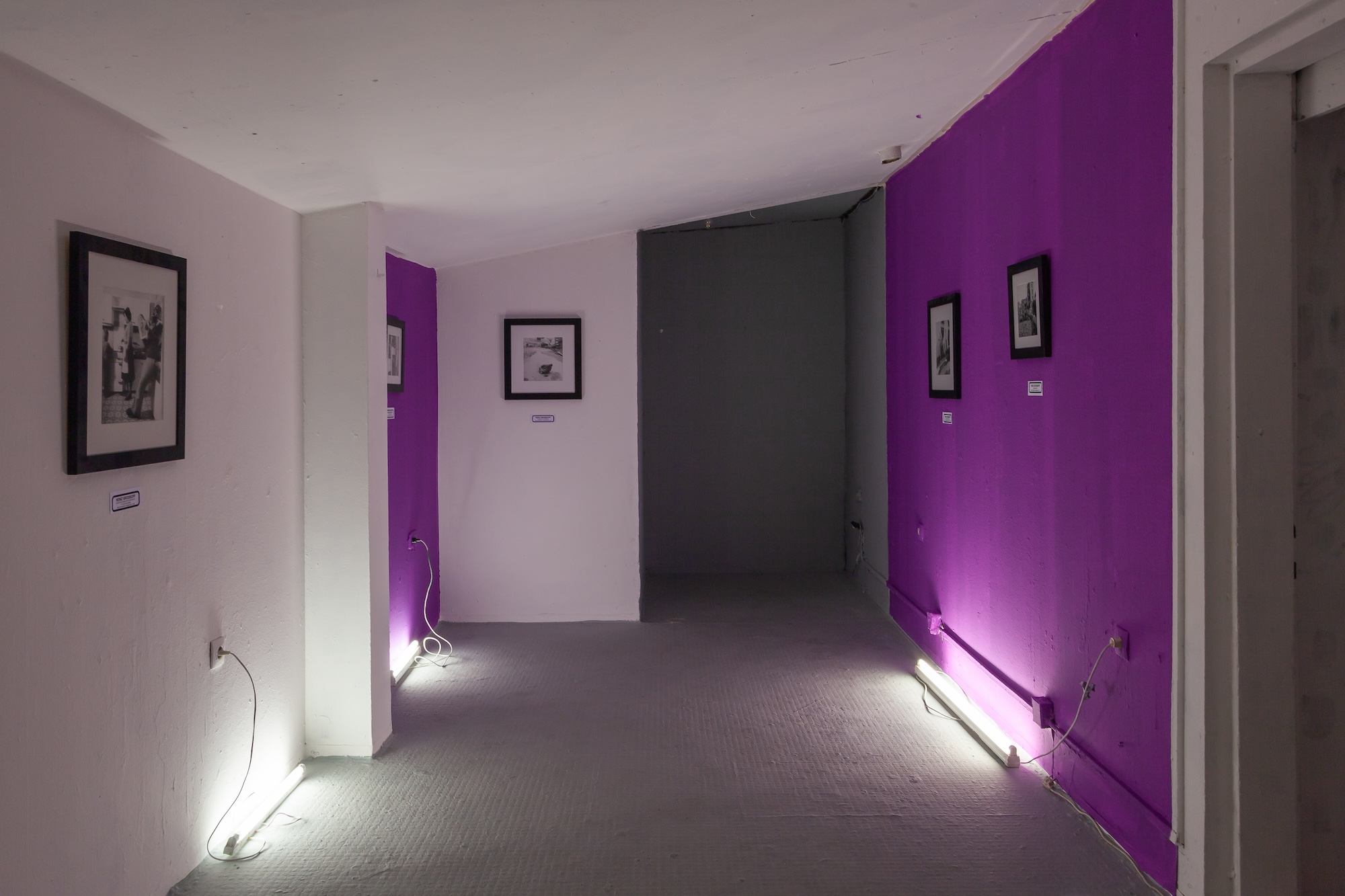
In this exhibition in the Kunsttankstelle Ottakring and the Masc Foundation, international artists question the truth content of photography under the title “What Is Real What Is Not”, making this year’s theme of the Foto Wien, “Photography Lies”, the artistic object of research for the 5 artists’ positions in each location. Heinz Grosskopf’s black-and-white photographs show the concrete city, the concrete district, the concrete street: Yppenplatz, Hubergasse, Hernalserhof – but only in sections, and thus we are only able to guess at the places, sometimes ascertaining it only when reading the title. The works seem to claim to be recording something, but can only achieve it in this fragmentary manner; the complete picture is left for us to assemble. The photograph of Hernalser Hof allows for a suspicion of how Grosskopf plays with his construction of stories and presentation: in the foreground there is a person who points their slingshot at the remaining ruins of the building. What is the truth content of the images of these places? And how can we locate fictitious narratives in photographs? In her diptych I am the shadow of my shadow, filmmaker and photographer Anna Mishina-Vaskova not only examines Vienna as a place, but relates the city to herself: Can the shadow serve as an image of the real self, and/or can it absorb me until I am nothing more than the image (of my shadow)? Can the shadow-image form its own independent identity, and what would it look like? Tracing the vestiges of her self in the streets of Vienna, and using digital image processing techniques, Mishina-Vaskova grants her shadow independence and thus questions the pure image and her reflection. In Daniel Longo’s black-and-white photographs, digital processing mainly stands out by the intensive light and sharp bright and dark contrasts. The images of the 2019 series ENTER AS STRAYS show people in situations unknown to us. We can only distinguish fragments of a scene in public transport and on a street. Simply looking at them, we are unable to detect any hints as to the photo’s backgrounds; reality and surreality seem to blur into each other with the intense contrasts and the lack of saturation. While we see realistic elements, we are unable to determine whether these places actually exist like that. Marija Šabanović and Apple Yi Jiang examine the different places of their origins and discuss possible parallels regarding the influence of the relationship between political systems and traditional cultures. The details of these questions are studied in the lifestyles, the living conditions of women in Yugoslavia and China. The installation confronts personal memories and the general history of several decades. The constant comparison of the different places produces spaces of independent reflection that we can make use of in order to question our memories and historical information. Ivan Lopez invites us to travel to a concrete place in the past. With a total of 14 photographs from 2007, he reconstructs an exhibition in the Masc Foundation 15 years ago using VR technology, and thus allows us to compare what we see with the perceived reality of the present exhibition space. The common thread in these artists might be their relation to space: With Grosskopf and Mishina-Vaskova having a noticeable and sometimes identifiable link to Vienna, Longo complicating definitive spatial identification, and Šabanović, Yi Jiang and Lopez depicting an image of concrete places and thus implicitly claiming to reconstruct them, we can appreciate the relevance of places for seeking and finding truth/factuality in the medium of photography.
What is Real What is Not (or: Establishing Truth in Space)
2–4.6.2023
masc foundation
Info
Keywords
Spaces
Artists
Heinz Grosskopf,
Daniel Longo,
Ivan Lopez,
Anna Mishina-Vaskova,
Marija Šabanović & Apple Yi Jiang,
Marija Šabanović,
Apple Yi Jiang